
Advisory Services Firm — G&D Consulting Group » Circular 0096 of 2026: 16 Labor Guidelines in Response to the National Disaster Situation
Paid Leave for Serious Domestic Emergency
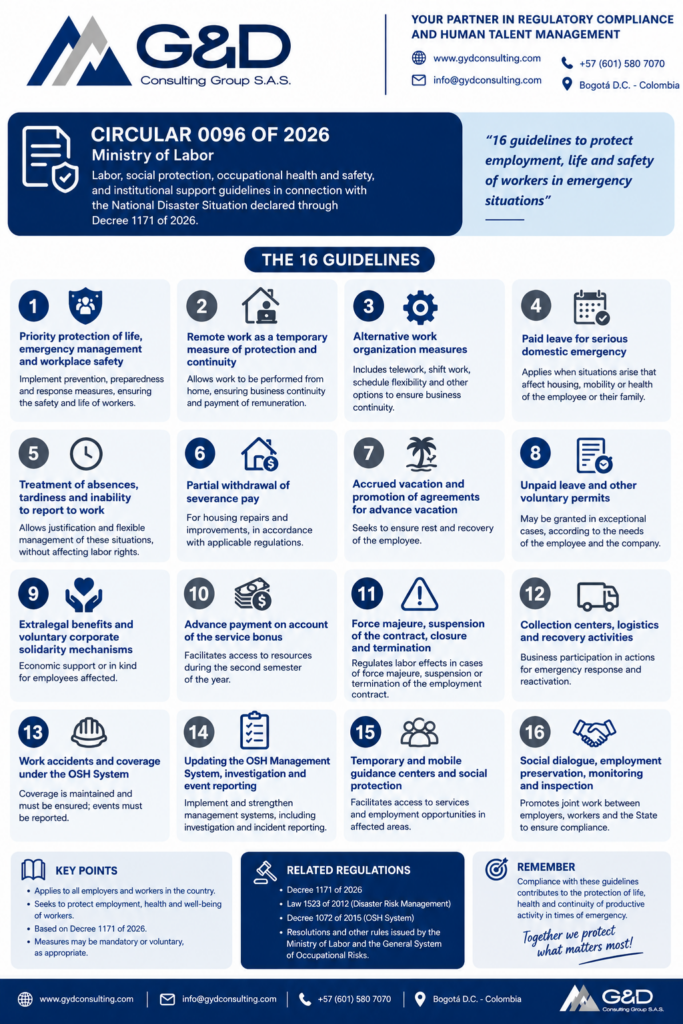
Circular No. 0096 of 2026, issued by Colombia’s Ministry of Labor, establishes 16 labor guidelines in response to the national disaster situation declared in Colombia. The measures address matters related to worker protection, remote work, domestic emergencies, partial withdrawal of severance pay, vacation, extralegal benefits, and the Occupational Health and Safety Management System (SG-SST). These provisions seek to guide employers and employees regarding the alternatives available to protect employment, address the consequences of the emergency, and ensure safe working conditions within the applicable legal framework.
The Ministry of Labor of Colombia issued Circular No. 0096 of August 13, 2026, establishing labor, social protection, Occupational Health and Safety (OSH), and institutional support guidelines in response to the effects caused by the earthquake recorded on August 10, 2026, and to the National Disaster Situation declared by the National Government through Decree 1171 of 2026.
The guidelines are addressed to employers and employees in the private sector, as well as to the territorial offices, special offices, and labor inspectorates of the Ministry of Labor.
The purpose of the document is to facilitate, within the applicable legal framework, proportionate labor responses that allow for:
- Protecting people’s lives and physical integrity.
- Preserving employment and income.
- Addressing urgent personal and family circumstances.
- Promoting the safe continuity of productive and service activities.
Circular No. 0096 serves as a reference document for employers and employees regarding the measures and guidelines issued by the Ministry of Labor in the context of the disaster situation.
Consult the original document below.
CIRCULAR No. 0096 OF 2026
Bogotá D.C., August 13, 2026
TO: EMPLOYERS AND EMPLOYEES IN THE PRIVATE SECTOR; TERRITORIAL OFFICES, SPECIAL OFFICES, AND LABOR INSPECTORATES OF THE MINISTRY OF LABOR
FROM: MINISTER OF LABOR AND VICE MINISTER FOR LABOR RELATIONS AND INSPECTION
SUBJECT: Labor, social protection, occupational health and safety, and institutional support guidelines in connection with the National Disaster Situation declared through Decree 1171 of 2026.
The Ministry of Labor, in exercise of its functions related to the formulation, direction, and guidance of public labor policy, the promotion of decent and dignified work, the protection of workers’ rights, and the inspection, monitoring, and enforcement of compliance with social regulations, hereby issues these guidelines in response to the effects caused by the earthquake recorded on August 10, 2026, and the National Disaster Situation declared by the National Government through Decree 1171 of 2026.
Their purpose is to facilitate, within the applicable legal framework, proportionate labor responses that protect life and physical integrity, preserve employment and income, allow urgent personal and family circumstances to be addressed, and promote the safe continuity of productive and service activities.
Articles 2, 25, and 53 of the Political Constitution impose on public authorities the duty to effectively protect rights, recognize work as a right and a social obligation receiving special protection from the State, and establish the fundamental minimum principles governing employment relationships.
Likewise, Decree-Law 4108 of 2011 assigns the Ministry of Labor functions relating to the formulation, direction, guidance, and evaluation of policies concerning work, labor relations, worker protection, social dialogue, and inspection, monitoring, and enforcement.
These powers authorize the Ministry to remind parties of the obligations currently in force, provide guidance on their application in extraordinary circumstances, and promote voluntary agreements when the legal system recognizes an area in which employers and employees may exercise discretion, without replacing the legislature or exercising regulatory powers through a circular.
On August 10, 2026, an earthquake measuring 7.4 Mw, with its epicenter in the municipality of San José del Palmar, Department of Chocó, was recorded. Subsequently, through Decree 1171 of August 11, 2026, the National Government declared a National Disaster Situation pursuant to Law 1523 of 2012.
Addressing the effects generated by this catastrophe requires consideration not only of the safety of workplaces, but also of its impact on housing, mobility, physical and mental health, family caregiving, household income, business continuity, and timely access to labor and social protection mechanisms.
The labor legal framework contains instruments that allow different consequences of the disaster to be addressed without creating exceptional regimes outside the law. These include the temporary authorization of remote work; paid leave for serious domestic emergencies; the taking of accrued vacation and the possibility of promoting agreements to take vacation in advance without altering the accrual rules; voluntary unpaid leave or permits; partial withdrawal of severance pay for authorized housing purposes; the voluntary adoption of extralegal benefits and other forms of corporate assistance; and the rules governing the General Occupational Risk System and the Occupational Health and Safety Management System (SG-SST).
The declaration of a disaster does not, by itself, modify the requirements for the accrual, recognition, or exercise of labor rights, nor does it automatically convert its consequences into a workplace accident, serious domestic emergency, force majeure preventing contractual performance, or just cause for termination.
The application of each legal institution depends on verifiable facts and on the requirements established by the Constitution, laws, and regulations. Likewise, solidarity or flexibility measures that are not legally mandatory may only be promoted as voluntary, mutually agreed upon, and properly documented alternatives.
Accordingly, this Circular distinguishes between:
a) obligations that already arise directly from the legal framework and whose compliance is reiterated to the recipients of this Circular;
b) alternatives that the Ministry invites the parties to consider or agree upon, without converting them into general mandates; and
c) institutional support measures whose operational implementation must be carried out through the corresponding internal administrative decisions.
None of its provisions may be interpreted as creating benefits, leave, grounds for severance-pay withdrawals, grounds for suspension or termination of employment contracts, work arrangements, or coverage under the General Occupational Risk System other than those established by the applicable legal sources.
In view of the foregoing, the Ministry of Labor issues the following guidelines:
1. Priority protection of life, emergency management, and workplace safety
Employers must implement the measures established under the SG-SST and their prevention, preparedness, and emergency response plans.
Where there is visible damage, preventive evacuation, access restrictions imposed by a competent authority, or circumstances that reasonably require verification of a building’s safety, the life and physical integrity of individuals must be prioritized, and ordinary occupancy should be avoided while the relevant assessments are carried out.
The identification of structural damage falls within the responsibility of the authorities, qualified professionals, or technically competent entities. Accordingly, cracks, detachments, or other issues must be assessed without administrative or labor assessments replacing the required technical diagnosis.
These actions are governed, among other provisions, by Articles 2.2.4.6.8 and 2.2.4.6.25 of Decree 1072 of 2015.
2. Remote work as a temporary protection and continuity measure
Law 2088 of 2021 and Section 7 of Chapter 6 of Title 1 of Part 2 of Book 2 of Decree 1072 of 2015, added by Decree 649 of 2022, regulate the authorization of remote work for employers and employees in the private sector in the event of occasional, exceptional, or special circumstances.
Employers are encouraged to consider this alternative when the nature of the duties allows them to be performed outside the usual workplace and when doing so is appropriate to protect employees, facilitate the handling of situations arising from the disaster, or maintain business continuity.
The authorization must comply with the communication, temporary nature, means, working conditions, and occupational risk-management requirements established under the applicable legal framework. Remote work does not constitute telework and does not permanently modify the place where services are performed.
3. Alternative work organization measures
When remote work is not feasible for all functions, employers may evaluate, within the legal, contractual, and SG-SST framework, temporary alternatives such as performing services at safe facilities, redistributing activities, alternating work arrangements, or adjusting schedules and shifts.
These measures must respect maximum working hours, rest periods, the right to disconnect, minimum and non-waivable rights, and matters requiring agreement with the employee.
They may not be used to transfer risks arising from unsafe workplace conditions to employees.
4. Paid leave for serious domestic emergency
Article 57(6)(c) of the Colombian Labor Code, as amended by Article 15 of Law 2466 of 2025, requires employers to grant the necessary paid leave in cases of a duly substantiated serious domestic emergency, under the terms established in that provision.
The earthquake does not automatically constitute a serious domestic emergency for all employees. However, its specific consequences may constitute such an emergency when a personal or family event, fortuitous event, or force majeure event, due to its seriousness, affects the employee’s normal performance of work activities.
Significant damage to housing, the urgent need to care for family members covered by the applicable provision, or serious personal circumstances directly resulting from the disaster must be assessed based on the documented circumstances.
The duration of the leave shall correspond to the time reasonably necessary to address the situation, and this Circular may not establish a general number of days.
5. Treatment of absences, tardiness, and inability to report to work
Employers must verify the circumstances explaining absences, tardiness, or inability to report to work related to mobility restrictions, evacuations, housing damage, transportation disruptions, urgent care for family members, injuries, compliance with instructions issued by authorities, or other consequences of the disaster before imposing disciplinary consequences.
Where disciplinary action is appropriate, the procedure established in Article 115 of the Labor Code, as amended by Article 7 of Law 2466 of 2025, must be guaranteed, including a genuine opportunity for the employee to explain the facts and challenge the evidence.
This guideline does not make every absence automatically justified. Rather, it requires an individual and objective assessment that respects due process and the legal framework applicable to the particular situation.
6. Partial withdrawal of severance pay for housing repairs and improvements
Article 256 of the Labor Code allows employees to request partial payment of their severance benefit for the purchase, construction, improvement, or release of real property intended for the employee’s housing, subject to the applicable legal and regulatory requirements.
In affected areas, where repair, adaptation, or improvement works fall within the purposes authorized by law, employees may use this mechanism. Employers or severance funds, depending on the applicable regime, must process requests within the scope of their respective responsibilities as promptly as possible and avoid unjustified delays.
This Circular does not create a special ground for withdrawal and does not exempt applicants from demonstrating the intended use of the funds or meeting any other applicable requirements.
7. Accrued vacation and promotion of agreements for advance vacation
Articles 186 and 187 of the Labor Code regulate the accrual, duration, and timing of vacation.
Employers and employees are encouraged to promote agreements allowing periods of already accrued vacation to be scheduled and, where convenient for both parties, to consider taking vacation in advance for a future accrual period as a temporary measure to address personal or family needs and support the preservation of the employment relationship.
In the latter case, written evidence should be maintained specifying the start date, duration, and future period to which the vacation will be allocated.
This recommendation does not modify the statutory accrual rules, permit already acquired vacation periods to be disregarded, or authorize the subsequent duplication of vacation already allocated on an advance basis.
8. Unpaid leave and other voluntary permits
Article 51(4) of the Labor Code provides for the suspension of an employment contract due to leave or temporary permission granted by the employer.
When an affected employee needs to be absent and paid leave or another mandatory right does not apply, the employee may request unpaid leave or a temporary permit from the employer.
This alternative must be voluntary and documented. It may not be imposed on the employee or used to replace paid leave for a serious domestic emergency, medical leave, accrued vacation, or another applicable right.
The parties must understand the legal effects of suspension of the employment contract and ensure that any deduction or compensation complies with the applicable regulations.
9. Extralegal benefits and voluntary corporate solidarity mechanisms
Employers with the capacity to do so are encouraged to consider voluntary support programs for affected employees, such as financial or in-kind assistance, food, transportation, temporary accommodation, housing repair assistance, internal solidarity funds, or loans on favorable terms.
The granting of such assistance should be adequately documented, identifying its purpose, beneficiary, amount or type of benefit, delivery conditions, and, where applicable, its relationship with pre-existing corporate policies.
The mere designation of a payment as an allowance, bonus, or form of assistance does not, by itself, determine its treatment for salary, benefits, tax, or social security purposes. Such treatment will depend on its nature and the applicable regulations.
10. Voluntary advance payment on account of the second-semester service bonus
As a measure of financial support, employers with sufficient financial capacity are encouraged to consider, following the employee’s prior information and acceptance, granting advances on account of the service bonus corresponding to the second semester of 2026.
The advance must be documented, expressly indicating that the amount paid will be credited against the bonus payable in December 2026, in accordance with Article 306 of the Labor Code, or against the final settlement if the employment relationship ends earlier.
The advance does not alter the accrual of the benefit and does not authorize waivers, deductions, or set-offs other than those permitted by law.
Upon settlement, any difference owed to the employee must be paid.
11. Force majeure, suspension of the employment contract, closure, and termination
Article 51(1) of the Labor Code provides for the suspension of an employment contract due to force majeure or a fortuitous event that temporarily prevents its performance.
It is reiterated that the mere occurrence of the earthquake or the declaration of a disaster does not automatically produce such an effect. There must be an actual and temporary impossibility causally linked to the event with respect to the employment contracts concerned.
In cases involving suspension due to force majeure or a fortuitous event, the employer must immediately notify the Labor Inspector of the relevant jurisdiction or, in their absence, the first political authority, so that the circumstances may be verified, in accordance with Article 67 of Law 50 of 1990.
The suspension of activities, collective dismissals, and permanent closure shall be subject to the legally applicable requirements and authorizations.
The disaster does not, by itself, constitute an autonomous just cause for termination of the employment contract under Article 62 of the Labor Code.
12. Corporate participation in collection centers, logistics, and recovery activities
Companies with technical, logistical, or human resources are encouraged to support, in coordination with the competent authorities, collection centers, aid distribution, and recovery activities consistent with their capabilities.
When company employees participate in these activities at the instruction, authorization, or organization of the employer, such tasks must be incorporated into the preventive management of the SG-SST, including hazard identification, risk assessment, information and training, control measures, and the necessary personal protective equipment, as well as coordination with the Occupational Risk Management Entity (ARL) within the scope of its responsibilities.
The voluntary participation of employees in an action organized by the employer does not, by itself, exclude the occupational health and safety obligations legally applicable.
For volunteers who are not part of the employment relationship, the applicable protection and coverage framework must be verified beforehand.
Under no circumstances should specialized search, rescue, structural intervention, or network-related tasks be assigned to persons who lack the required training and authorization.
You may also be interested in reading more about Unpaid Leave in Colombia.
13. Workplace accidents and scope of coverage under the General Occupational Risk System
Under Article 3 of Law 1562 of 2012, a workplace accident is a sudden event arising from or occurring in connection with work that produces the consequences established by law.
The provision also covers accidents occurring while carrying out the employer’s instructions or performing work under the employer’s authority, even outside the workplace and working hours, as well as accidents occurring while transporting employees from their residence to the workplace or vice versa when transportation is provided by the employer.
Therefore, an injury caused during the earthquake is not automatically considered work-related. It must be established whether the statutory requirements and the connection with the work are present.
Coverage by the Occupational Risk Management Entity does not arise from an ad hoc agreement between the parties, but from the fulfillment of the requirements established under the General Occupational Risk System.
When these requirements are met, the corresponding reporting, medical care, and benefit-recognition mechanisms must be activated.
14. Updating the SG-SST, investigation, and reporting of events arising from the emergency
Employers must review events occurring during the earthquake and its aftershocks that are relevant to occupational health and safety and, where appropriate, update hazard identification, risk assessment and evaluation, controls, and prevention, preparedness, and emergency response plans.
Accidents and incidents must be reported and investigated in accordance with the applicable provisions, including Decree 1072 of 2015 and Resolution 1401 of 2007.
In particular, the reporting obligations established in Article 2.2.4.1.7 of Decree 1072 of 2015 must be observed when the relevant requirements are met.
The occurrence of the disaster does not suspend or replace these obligations. On the contrary, it requires the information obtained to be incorporated into preventive management and used to adopt improvement measures.
15. Temporary and mobile labor and social protection guidance centers in affected areas
The Ministry of Labor will progressively strengthen its presence in prioritized territories through temporary or mobile guidance centers, itinerant inspectors, and teams coordinated with the Territorial Directorates and, where applicable, with the Vice Ministry of Employment and Pensions and other competent departments and entities.
These mechanisms will be aimed at:
a) providing information to employees and employers regarding disputes, suspensions, terminations, leave, and other employment situations arising from the emergency;
b) facilitating access to inspection, monitoring, and enforcement channels;
c) guiding and referring individuals who meet the requirements to the Unemployment Protection Mechanism, created by Law 1636 of 2013 and amended, among others, by Law 2225 of 2022, the Public Employment Service, and the services or benefits administered by the competent entities of the Social Security System; and
d) supporting interinstitutional coordination for cases that fall outside the Ministry’s jurisdiction.
The Circular does not automatically grant subsidies or benefits. Access to these depends on the applicable legal requirements and the decision of the competent entity.
The definition of teams, itineraries, assignments, responsible parties, and other operational matters will be carried out through the corresponding internal administrative decisions.
16. Social dialogue, employment preservation, monitoring, and inspection
Employers, employees, and their organizations are encouraged to prioritize dialogue, good faith, conflict prevention, and the adoption of proportionate measures that promote employment preservation and the safe recovery of productive activities.
The Territorial Directorates and Labor Inspectorates will provide guidance within the scope of their responsibilities, receive legally applicable notices and requests, and carry out the inspection, monitoring, and enforcement activities that may be required.
Corporate measures must be coordinated with evacuation, closure, mobility restriction, access restriction, and other decisions issued by the competent risk-management authorities, without prejudice to corporate autonomy in areas recognized by law and full respect for employees’ minimum and non-waivable rights.
These guidelines must be applied in accordance with the circumstances of each employment relationship and the responsibilities of the authorities and entities involved in responding to the disaster.
They do not replace the technical, administrative, or judicial decisions that may be applicable, nor do they create new rights, benefits, leave, grounds for suspension or termination, severance-withdrawal mechanisms, methods of providing services, or circumstances giving rise to coverage under the General Occupational Risk System.
Sincerely,
NATALIA EUGENIA LÓPEZ FUENTES
Minister of Labor
JULIANA PATRICIA MORAD ACERO
Vice Minister for Labor Relations and Inspection
If you have any questions, you can contact our team here.