

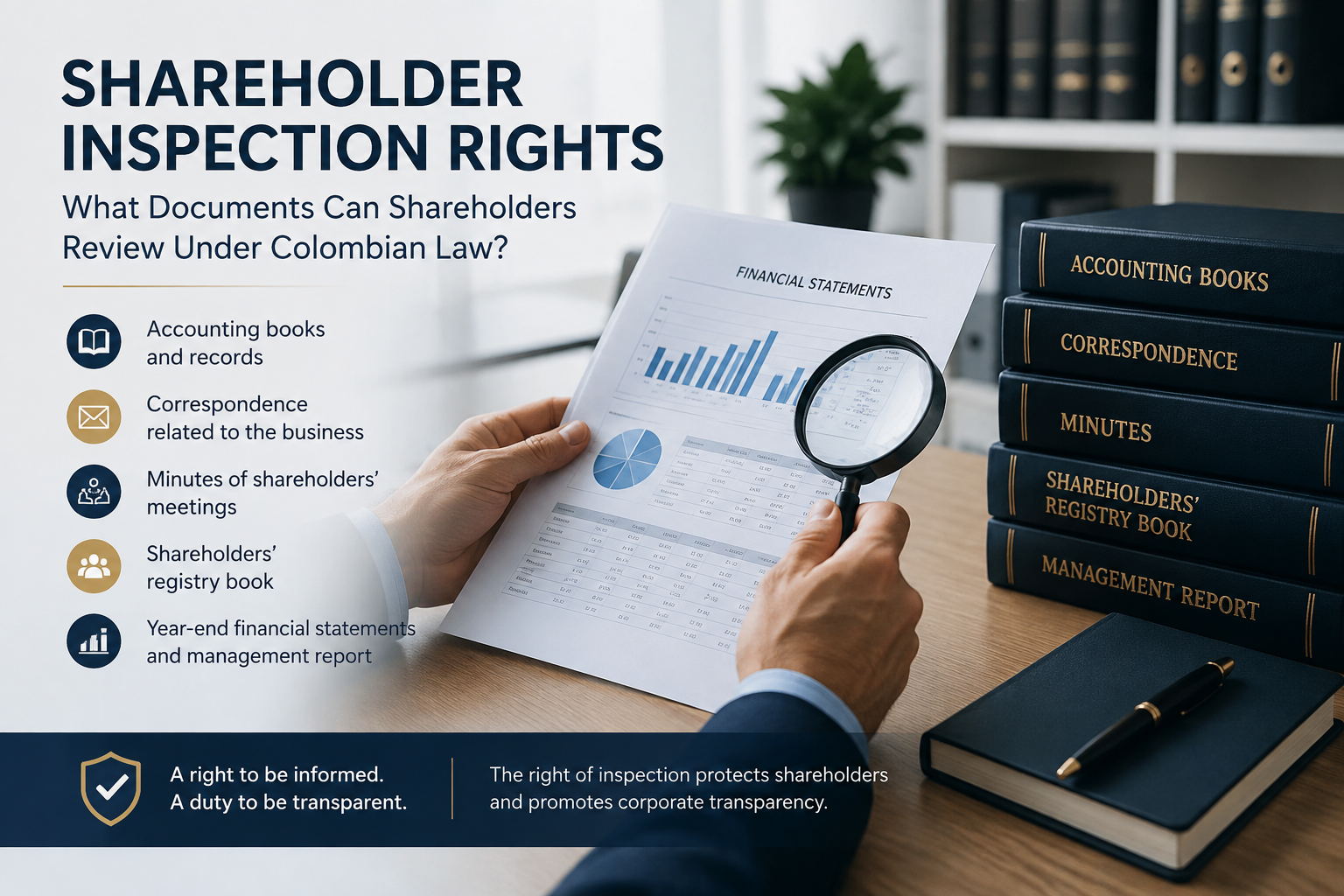
A shareholder who does not participate in the management of the company nevertheless has the right to directly review the company’s books and records. However, this right is not unlimited: it only covers certain documents and does not include the right to take copies. The Basic Legal Circular precisely defines the scope of this right.
Many shareholders assume that the right of inspection allows them to request any company document or make copies of everything they review. Neither assumption is correct. The Superintendence of Companies precisely defines which records are subject to this right and clarifies what shareholders may and may not demand when exercising it.
The right of inspection covers accounting books, correspondence related to the company’s business, minutes of shareholders’ meetings or partners’ meetings, the shareholders’ registry book, and year-end financial statements together with the management report. This right does not include the authority to demand copies of such documents.
What documents are covered by this right?
The law expressly identifies the documents that must be made available to shareholders: accounting books and their supporting documents, correspondence related to the company’s business, the minutes books of shareholders’ or partners’ meetings and, where applicable, the board of directors, the shareholders’ registry book, and year-end financial statements together with the documents that the legal representative must submit to the highest corporate body. This is not an open-ended list: shareholders cannot demand access to commercial or employment contracts, internal budgets, or other documents that are not expressly covered.
Can a shareholder take copies of the documents reviewed?
This is the issue that generates the most friction in practice, and the answer is clear: no. The right of inspection is intended to allow shareholders to verify the contents of the documents, not to obtain copies of them. The fact that management refuses to provide copies does not, in itself, constitute a violation of the right of inspection. The highest corporate body may, however, authorize through its own internal rules that shareholders be allowed to obtain copies—but this is an internal decision, not a statutory obligation.
Can a shareholder take notes while reviewing the documents?
Although a shareholder may not make copies or write annotations on the documents themselves, the Superintendence of Companies clarifies that the shareholder may take notes on a separate piece of paper—a sheet, notebook, or agenda—separate from the document being reviewed. This allows the shareholder to prepare for the shareholders’ meeting without compromising the confidentiality of the original information.
What happens if a director or officer prevents the exercise of this right?
Respecting the right of inspection is, in itself, a legal duty of the company’s directors and officers. Anyone who prevents its exercise may be subject to removal, and the statutory auditor who becomes aware of the violation and fails to report it in a timely manner may also face the same consequence. If a shareholder believes that their right of inspection has been denied, they may turn to the Superintendence of Companies, which has the authority to resolve the dispute and, where warranted, order that the information be made available.
Understanding the precise limits of this right helps avoid two opposite mistakes: a shareholder demanding documents or copies that the law does not cover, and a director or officer restricting access to information that the company is legally required to make available. In both cases, clarity regarding the scope of the right protects both the shareholder and those responsible for managing the company.